When The Indian Express published its “unprecedented rupture” on 23 September, the plot was simple. Two Election Commissioners, Sukhbir Singh Sandhu and Vivek Joshi, had objected “at least 14 times” to decisions taken, they said, “without their knowledge.” The CEC ran a one-man show; a constitutional body was in crisis.
Within hours the opposition had the script, the studios the graphics, the streets the marchers. Rarely has a single newspaper report produced so much anarchy out of so little evidence.
Five weeks later, the plot has a problem: its two heroes have signed for the other side.
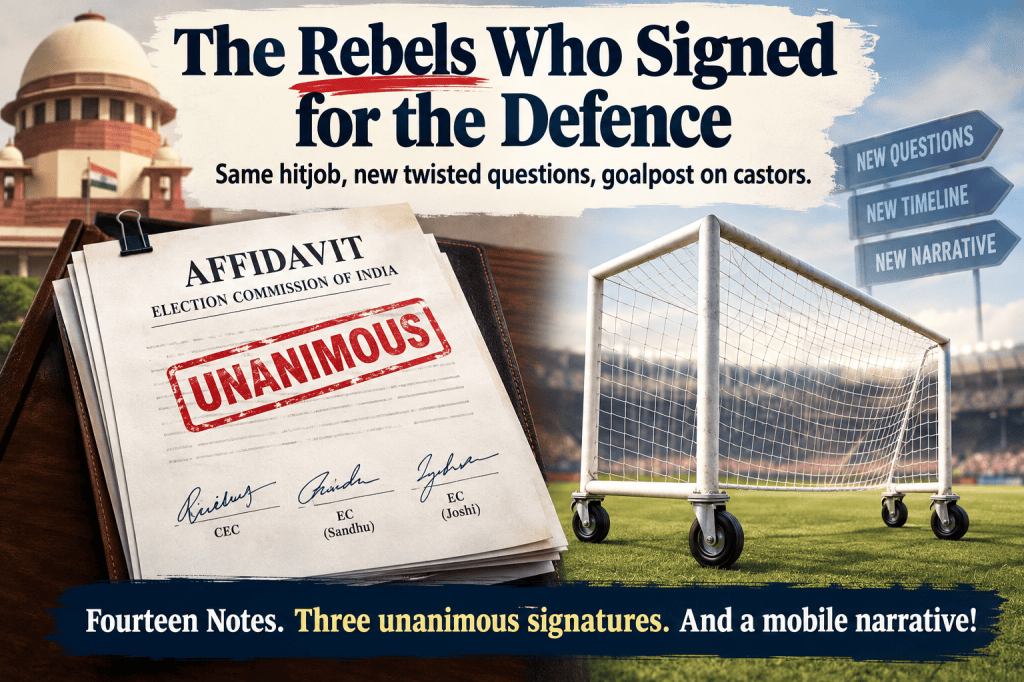
On 26 October, the Commission filed a 250-page counter-affidavit in the Supreme Court, approved by all three members: the CEC, Sandhu and Joshi. It states that the three SIR orders, of 24 June 2025, 27 October 2025 and 14 May 2026, were unanimous decisions under Article 324 and Section 18 of the 2023 Act. It calls the petitions built on the Express report “misconceived.”
The very two men whose notes were meant to prove the CEC acted alone approved a sworn document saying otherwise. The whistleblowers have blown the whistle on the story.
Goalposts, now on castors
So what does a newspaper do when its star witnesses sign for the defence? It doesn’t retract. It relocates. As I wrote last time, these goalposts come with wheels, a driver and a GPS apparently set at 10 Janpath. The Express has floored the accelerator.
The new line from Ritika Chopra and her paper: many objections came after actions were taken, so the unanimous orders answer nothing. Note the downgrade.
In September the charge was decisions “without their knowledge.” In October it’s timing. The “unprecedented rupture” has shrunk to a dispute over who initialled which file, and when. At this rate, by Diwali the scoop will be that a Commissioner was once served tea without ginger.
This version quietly concedes the main point and hopes nobody notices. If the three SIR orders were unanimous, the central charge, that the CEC ran the SIR on his own, is dead. What’s left is the ordinary friction of any multi-member body, sold as scandal with the confidence of a man selling sand in the Thar.
The best example is the work-allocation order of 28 July. The two Commissioners countermanded it on 30 July; the affidavit says it was never implemented. That was the “radical departure” behind the letters to the Cabinet Secretary. An officer overstepped, two Commissioners stopped him, the system worked. Breaking news: “the brakes work.”
The Express spent five weeks documenting Section 18 working as written, and called it a breakdown. That’s not journalism; it’s an accident report on a car that stopped at a red light.
A file note became a headline
The affidavit states what every first-year administrator knows: queries and objections recorded on a file are not decisions. File noting is how a file thinks out loud. A Commissioner who questions a proposal and then signs the final order hasn’t been overruled. He has been persuaded, or improved the proposal, or both.
If every query on a file were mutiny, every ministry in Delhi would be in permanent civil war, and every concurring judgment a coup.
Form 6: from “illegal” to “let’s check the file”
In September, a file note calling the Form 6 change “unauthorised and illegal” was printed as a verdict. In October, the Commission states under oath that the statutory Form 6 was never amended; a supplementary declaration was added for the SIR. The Supreme Court wants the records of what changed and who changed it. Good. So does everyone.
Notice the journey: what the Express sold as settled fact is now, by everyone’s admission, for the records to decide.
Isn’t investigative journalism meant to uncover facts, not dress up allegations as facts? Nobody disputes the notes exist. But a note proves only that someone wrote it. It doesn’t prove what the Express built on it: illegality, a one-man show, a ruptured institution. Sources give leads; evidence must carry the claims. Without it, you have speculation with a press card, or a hit job dressed up as journalism.
The street and the courtroom
The street got its day in court, and the court did not join the march. It refused to suspend the CEC, sought responses and said it would examine the records. Alas for the marchers!
That is where Harish Salve said it belonged all along: a courtroom, where files are read, not a studio, where they are paraphrased. The marches and resignation demands rested on notes whose own authors now affirm, before the Supreme Court, that the orders at the storm’s centre were unanimous.
Three questions in five weeks
September’s question: did the CEC act alone? October’s: when exactly were the notes written? November’s, perhaps: did anyone at the Commission ever disagree with anyone about anything? How undemocratic!
Brace yourselves: they did. That’s what a Commission is for. Parliament made it three members, not one, so they could argue, object, outvote one another and then decide together. They did all that, then swore to it.
A newspaper confident of its story would wait for the files, not change the question weekly. Perhaps the Express owes an apology to the Delhi traders who spent weeks dodging marches over what turned out to be a scheduling dispute. File notings were sold as rebellion; the shopkeepers paid the bill.
The rebellion has been put down, and it was the rebels who put it down. What shameless lot.


Leave a Reply