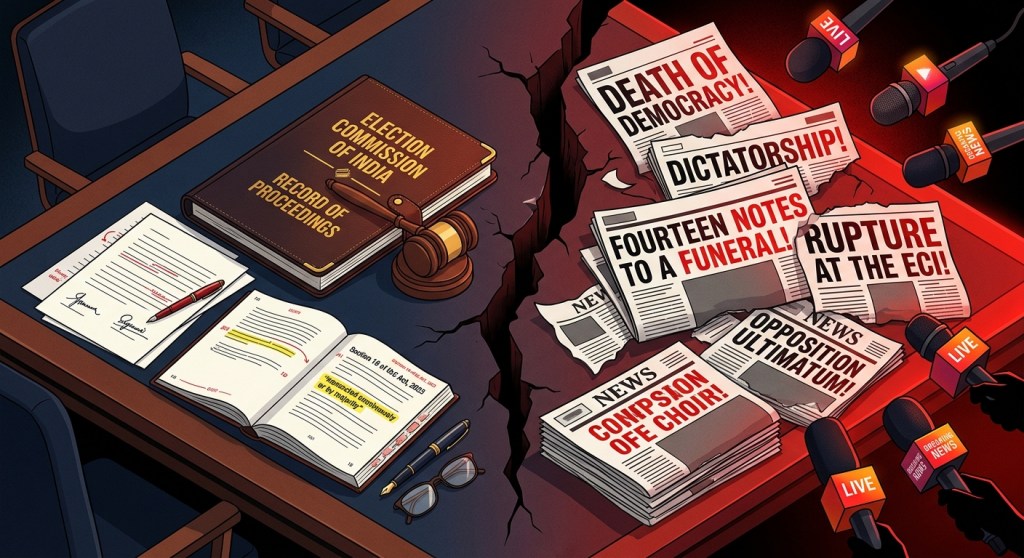
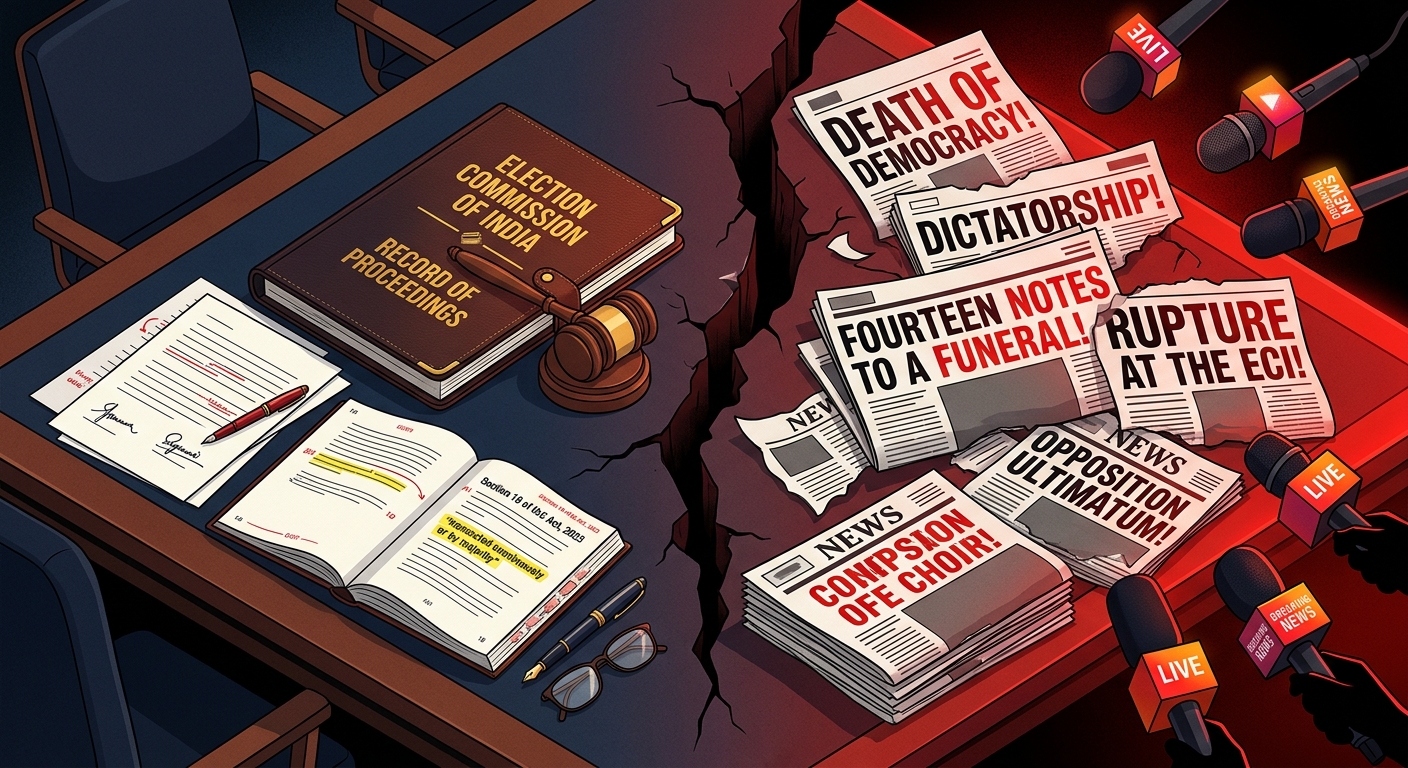
Blow the conchs. Light the candles at India Gate. Somebody please book a slot at the UN. A newspaper has discovered that inside the Election Commission of India, two of the members wrote things down.
Fourteen times. In ten months. Four of them, we are breathlessly told, on a single day, as if four file notes before lunch were India’s storming of the Bastille. The Indian Express calls it “an unprecedented rupture.” Any retired Joint Secretary would call it a Tuesday.
The investigation contains its own rebuttal. It quotes Section 18 of the 2023 Act governing the Commission: business shall “as far as possible” be transacted unanimously, and where commissioners differ, the matter “shall be decided according to the opinion of the majority.” Parliament didn’t merely allow commissioners to disagree. It wrote the rulebook for what happens when they do. Now, who will tell these morons that disagreement isn’t a malfunction of the machine? It is the machine.
Harish Salve, former Solicitor General, made the point the outrage merchants keep stepping around. The Commission has three members with equal powers and decides collectively, by unanimity or majority, so its actions can’t fairly be pinned on one man. Yet the entire campaign demands the head of one individual for the decisions of a three-member body. You can’t call the Commission collective in one breath and impeach it one commissioner at a time in the next.
Now the saga’s climax: the “radical departure” in which two commissioners wrote to the Cabinet Secretary. Per the Commission’s press note, the letter concerned an officer on deputation, not policy. The officer’s work redistribution orders “were not actually implemented after the orders of the two Commissioners.”
An officer issued an order. Two commissioners objected. The order died. That is exactly what Section 18 prescribes. The Express spent ten minutes of reading time proving that the law works and titled it a crisis. And the proven mediacrooks called it investigative journalism. Whoa!
Heads, dictatorship. Tails, rupture.
For years the complaint was that the Commission was a rubber stamp. Now its members argue, object and push back in writing. Proof of independence? Don’t be silly. Agreement is “dictatorship.” Disagreement is “rupture.” The only acceptable Election Commission is one that delivers whatever result the losing side pre-ordered.
On 26 September the full Commission, Sandhu and Joshi included, met. Its press note, bearing “the approval of the full Commission,” records that the SIR order of 24 June 2025 and the SIR schedules that followed were all unanimous, and that the Supreme Court upheld the order on 27 May 2026.
Let that sink in. The two supposed rebels have put their names to a document confirming that the key decisions were unanimous. Either the heroes of this story are secret collaborators, or the story was never what it was sold as.
Point by point
The Form 6 “illegality.” The article’s centrepiece is a file note calling the new Form 6 question “unauthorised and illegal.” But the Supreme Court, which outranks a file note, has upheld the declaration attached to Form 6 for SIR. Salve adds the distinction the breathless coverage ignored: digital validations to catch duplicate or fraudulent entries change how data is collected, not the Registration of Electors Rules themselves. The objection was recorded and debated. That’s called deliberation.
The “centralisation” of the voter database. The dark warning is that Delhi is quietly seizing the rolls from local EROs. The Commission’s answer: field officers have role-based access according to their statutory powers; a committee including an independent IIT/IIIT expert will review ECINet; and every new IT initiative will first go through the Committee of Officers. What a curious dictatorship, one that invites an outside auditor to inspect its own servers.
Goa’s 97 voters. Ninety-seven eligible voters left off the final roll because the software lacked a rollback option in time. A portal was missing a button. That’s a bug ticket, not a coup. The fix? BLOs went house to house, and 81 of the 97 have already filed Form 6. If this is voter suppression, it’s the first in which the suppressors come to your door to put you back on the roll.
West Bengal. Here the investigation undercuts its own subtext, admitting there was no evidence of the SIR’s role in the outcome. In the 49 seats where deletions exceeded the victory margin, the BJP won 26 and the TMC 21. The most sinister rigging operation in history handed nearly half its “rigged” seats to the opposition. Whoever designed it should be fired for incompetence.
The strangest voter-suppression plot ever devised
And the “captured” Commission’s next move? It extended deadlines in Delhi and Maharashtra. It ruled that people with notices need not visit any office: BLOs will collect documents at home. It ordered help desks and special camps for the homeless, labourers and the poor, and launched a special enrolment drive for anyone left out.
Deadline extensions. Doorstep collection. Camps for the homeless. If this is how the Commission steals votes, one shudders to imagine what it would do if it wanted to help voters.
The political response
The response was, as always, a model of restraint. Demands against the CEC ranged from removal and impeachment to arrest. The cockroaches issued a 48-hour resignation ultimatum.
Salve’s advice was disarmingly simple: if you suspect irregularities, go to the Supreme Court or a High Court, where the official files can actually be examined, instead of taking to the streets. That’s the trouble with courtrooms: they demand evidence and ignore hashtags. Guess which venue the opposition prefers.
The script never changes. Win, and it’s the voice of the people. Lose, and it’s the EVMs. Then “vote chori.” Now “note chori.” The goalposts now have wheels, a driver and a 10 Janpath-generated GPS.
While Gyanesh Kumar was Election Commissioner, the Commission conducted the 18th Lok Sabha elections and the assembly polls in Haryana, Maharashtra, Jharkhand, Delhi and Jammu and Kashmir. In the Lok Sabha, the all-powerful rigging machine let the ruling party fall short of a majority on its own. In Jharkhand and J&K, opposition parties formed governments. The master manipulator keeps forgetting to manipulate.
As for anti-incumbency, it comes from the public mood, not from political entitlement. And who will tell the Clown Prince that it is he, with his politics and rhetoric, who keeps scaring the electorate back into the arms of the incumbent?
Three commissioners disagreed. Two put their objections on record, exactly as the law expects. When an officer overstepped, the majority stopped the order. The full Commission then reaffirmed its unanimous decisions, ordered an independent IT audit, extended deadlines and sent officials door to door to put people back on the rolls. The two “dissenters” signed off on all of it.
That isn’t an institution collapsing. It’s an institution correcting itself in public. The real scandal isn’t that the commissioners disagreed. It’s that a disagreement, resolved by the procedure Parliament prescribed and by the Supreme Court’s ruling, was sold to the country as a coup.
The referee isn’t the problem. The problem is the entitled people who only accept the referee when they’re winning.


Leave a Reply