India’s reservation system began as an act of constitutional conscience and has become the most durable political instrument in the Republic’s history. An honest debate holds two truths at once: reservation was a moral necessity in 1950, and what exists today – expanding, permanent, communalised and politically untouchable – bears little resemblance to what the framers designed.
A third truth, harder for its own critics to swallow, is that the movement now forming against it is aimed at the wrong target and may deliver the opposite of what it wants.
When the Constituent Assembly met, it confronted a society in which communities (partially, not entirely) had been denied education, temple entry, public employment and basic dignity for centuries under untouchability. Reservation for Scheduled Castes (SC) and Scheduled Tribes (ST) was atonement for a historic ill, and the one category that found unanimous acceptance. The logic was unimpeachable: formal equality of opportunity is meaningless for people forbidden from acquiring the qualifications it presupposes.
Articles 15(4) and 16(4) enabled special provisions in education and public employment; Articles 341 and 342 empowered the President to notify SCs and STs; Article 334 reserved legislative seats for a defined period. Reservation was a ladder for the historically excluded to enter public life – a corrective mechanism, not a spoils system.
Dr Ambedkar is routinely distorted, and a coherent debate must begin by getting him right. In the Constituent Assembly on 30 November 1948, he accepted equality of opportunity as a great principle. Still, he insisted on provisions to ease the entry of communities historically shut out of public employment. Crucially, he added a limit: reservation should always be confined to a minority of seats, warning that if quotas took 70% of positions and left only 30% open, equality of opportunity would be destroyed.
He saw reservation as a transitional, minority-of-seats instrument tied to demonstrable exclusion – never a permanent proportional entitlement.
The irony is that the “jitni abadi, utna haq” camp, demanding quotas proportional to caste-census population that could exceed 70-80% in places, misuses his name most of all.
The Communal Perversion
The framers deliberately rejected religion-based reservation. The Advisory Committee headed by Sardar Patel – including Ambedkar, Maulana Azad, S.P. Mookerjee and K.M. Munshi – recorded that minorities themselves felt statutory reservation for religious minorities should be abolished.
The 1950 Presidential Order accordingly confined Scheduled Caste status to Hindus, extended to Sikhs in 1956 and neo-Buddhists in 1990: caste, as the framers understood it, is a feature of Hindu society, and conversion to a faith claiming to be casteless extinguished the disability the quota remedied.
Political parties have since worked to smuggle religion back in. Andhra Pradesh’s 2004 announcement of a 5% Muslim quota – stayed within days – drew L.K. Advani’s warning that it would sow the poisonous seed of the Two-Nation theory. Mamata Banerjee’s government stuffed 77 communities, overwhelmingly Muslim, into West Bengal’s OBC list until the Calcutta High Court struck it down. Karnataka’s blanket Muslim OBC reservation, and “Scheduled Caste Converts to Christianity” parked under OBC, follow the same pattern. Nehru’s own 1961 letter to Chief Ministers condemned reservation on communal considerations: ‘this way lies not only folly but disaster.‘
The Great Fragmentation
The Mandal Commission (1979) recommended 27% reservation for Other Backward Classes (OBC); V.P. Singh’s abrupt implementation in August 1990 detonated Indian politics. Rajiv Gandhi, in a marathon speech that September, accused him of igniting caste violence and asked the question that still haunts the system: ‘should a backward-class judge of fifteen years’ standing, turned minister, pass reservation benefits to his children while the truly needy are pushed aside?‘ The Supreme Court’s Indra Sawhney judgment (1992) upheld OBC reservation but imposed the 50% ceiling, mandated creamy-layer exclusion, and struck down the day’s 10% economic quota.
Mandal’s deeper legacy was political. It made caste the permanent currency of electoral mobilisation, splintering Hindu society into competing quota constituencies – OBC against general, sub-caste against sub-caste. The Rohini Commission later documented the rot: roughly ten OBC castes cornered about a quarter of all OBC benefits while hundreds got almost nothing. Post-Mandal politics became a permanent bidding war in which every party competes to deepen the divisions reservation was meant to heal.
What Has Reservation Actually Achieved?
The record is mixed, and a serious debater should concede the truth. Reservation created a Dalit and backward-class middle class, seeded representation in the services and legislatures, and gave dignity and voice to communities that had none – all of it, limited to the privileged section of those castes. Discrimination has not vanished either; prejudice outlives statutes and demands to end SC/ST reservation are rarely accompanied by data.
Has it brought substantive representation based on caste?
Measured against seventy-five years and its own goals, the system has under-delivered. Benefits pooled within a creamy layer – the officer’s child with coaching, networks and English-medium schooling out-competing the landless labourer’s child of the same caste. Elite capture within OBC, SC and ST lists is documented, yet governments refuse creamy-layer exclusion for SC/ST. The poorest remain where they were; reservation reached those already positioned to use it.
A policy that, after three generations, still claims its beneficiaries are as disadvantaged as in 1950 is either failing or being deliberately perpetuated – it cannot claim success and permanence at once.
The Merit Question
Reservation’s design quietly erodes open competition. Because quotas are fixed percentages, every seat expansion enlarges reserved seats automatically while open seats stay a shrinking share – the 2006 OBC expansion promised extra seats most colleges never fully added. General-category candidates, including the poor among them, compete for under half the seats against the entire applicant pool, at sharply higher cut-offs.
The consequences are no longer abstract: in NEET-PG 2025, candidates scoring as low as ‘minus 40’ out of 800 qualified for counselling and were allotted seats. Nehru foresaw this in 1961 – caste reservations, he wrote, ‘swamp the bright and meritorious and keep the country second-rate.’ Celebrating individual reserved-category toppers does not answer the lowered entry bars in medicine, engineering and administration, where average preparation affects patient safety and institutional quality – nor the quiet emigration of talented general-category youth who conclude the system has no place for them.
A minimum qualifying merit across all categories, and protection of open seats as a fixed minimum number rather than a shrinking percentage, are the least the merit principle demands.
The EWS Angle
The 103rd Amendment (2019), brought by this Modi Government and upheld by the Supreme Court in 2022, created a 10% quota for Economically Weaker Sections (EWS) – a tacit ideological concession that deprivation is also economic, and that poor Brahmins, Rajputs, Bhumihars, Kayasths and Banias also exist. It is also the one measure in seventy-five years that expanded rather than contracted the general category’s options.
Yet EWS exposes the system’s contradictions rather than resolving them. It breached the very 50% ceiling used to strike down Maratha reservation. Its ₹8 lakh threshold is loose enough that fraud is rampant; its low cut-offs in some exams reflect poor design and thin applicant pools, not general-category weakness. And EWS candidates are denied the age relaxations and fee concessions other reserved categories enjoy – a poor upper-caste youth is the only reserved beneficiary treated as second-class within his own quota. Fixing that asymmetry is a modest, winnable demand that no party has an obvious reason to refuse.
The Political Hypocrisy
Here the case writes itself. The judiciary that lectures the nation on quotas exempts itself: barely 3% of High Court and Supreme Court judges are Dalits, and the collegium faces no reservation.
Congress, the party of Nehru’s “folly and disaster” letter and Rajiv’s anti-Mandal thunder, now demands a caste census and removal of the 50% cap. Mayawati denounces even an economic-criteria demand at Jantar Mantar as anti-national while conceding, in the same breath, that the existing system has left her constituents in poverty for seventy-five years – an admission that the machinery has failed, framed as a reason to preserve it. Akhilesh Yadav has declared that even the words “review,” “reform” and “creamy layer” are masks for conspiracy – which is to say, the vocabulary of reform is itself now forbidden. However, Mayawati’s charge that a corrupt implementing system, not the policy, has failed the poor deserves an answer rather than a sneer.
Reforms requiring no constitutional amendment – sub-categorisation, removing over-represented castes from state lists, creamy-layer enforcement, verification of fraudulent certificates – lie unused because quotas are the core of electoral mobilisation and touching them is political suicide. Every party is trapped in a system it privately knows is broken. Ideas like “One Family, One Reservation” and ‘One-time, One-generation’ benefits are dismissed not on merits but on arithmetic: the beneficiary bloc is too large to defy.
The Honest Question
The BJP did not create reservation, did not campaign to remove it, and has never carried its removal in a manifesto. What it did do was introduce EWS – the only quota ever created for the marginalised within the general category. Its leadership has stated plainly that existing quotas will not be touched. One may find that disappointing but cannot call it a betrayal of a promise never made.
Meanwhile, the alternatives are not neutral. Congress campaigns on removing the 50% cap and on a caste census whose only logical destination is proportional quotas. Rahul Gandhi has floated private-sector reservation – the 90-odd per cent of employment quota politics has never touched, and the last refuge of the general-category graduate. Regional parties campaign on religion-based sub-quotas that would divide the pie further and breach the line the framers drew.
So, the arithmetic of a general-category revolt is brutally perplexing. At roughly a fifth of the electorate, it has real influence but cannot by itself set any party’s strategy. Damaging the one party not promising more reservation, where every alternative promises precisely that, does not produce reform. It produces private-sector quotas, a caste census, a shattered 50% ceiling – and a general category with less than it started with.
Blaming the BJP is easy; the repercussion would be self-inflicted.
This is not an argument for silence or subjugation, and the contradiction in the pro-status-quo taunt should be named: critics are told simultaneously that speaking out is dangerous because it might weaken the BJP, and that it is pointless because no party can act anyway. Both cannot be true. What follows is a distinction, not a surrender.
The UGC Promotion of Equity Regulations are a separate and legitimate fight and must be revoked. Defining campus caste discrimination to exclude the general category from protection is indefensible on its own terms: rules meant to eliminate casteism cannot themselves be caste-selective. Left standing, they will be misused as instruments of grudge and career destruction, dividing campuses rather than uniting them. That demand is winnable, needs no amendment, and costs the government little.
Reservation itself is not that fight – not yet.
Reservation reform is not top-down; no single party can be asked to swallow a poison its rivals will profit from. It is bottom-up. Consensus has to be built at ward, municipal and district levels, then carried upward through MLAs and MPs, until the question becomes a ballot issue rather than a hashtag. Every party will move the day it costs them more to refuse than to act, and not one day earlier.
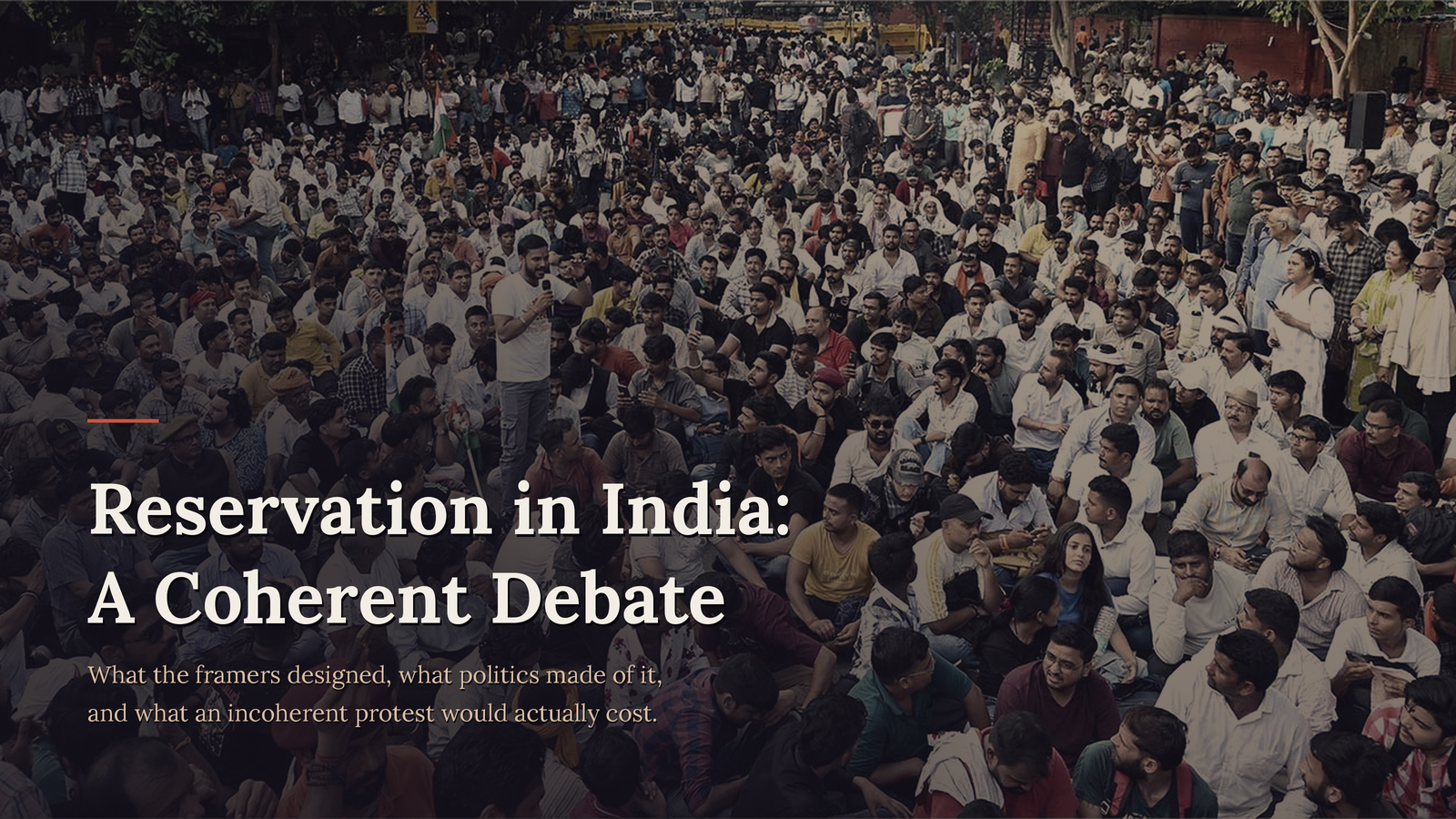
The Jantar Mantar model will not get there. Every generation believes its youth uniquely fearless; the Emergency and the JP movement had their students, Mandal had Rajiv Goswami, Nirbhaya and India Against Corruption had theirs. They teach one lesson: protests succeed at optics, while real change happens in the corridors of Parliament and government offices. A minister’s resignation is the lowest-hanging fruit, and the minister usually returns. Thirty days of protest creates no leader, and no reform.
The credible program, then, is narrow and unglamorous: revoke the UGC Equity Regulations now; fix the EWS asymmetries on age, fees and verification; press for creamy-layer enforcement, sub-categorisation and list-pruning, all already within existing powers; defend the 50% ceiling and the bar on religion-based quotas in court; and above all, back whichever party pursues growth that expands the pie, since a larger economy creates opportunities faster than any quota redistributes them.
Build the electorate first. Then negotiate.


Leave a Reply