Thirteen Years of “Atonement”
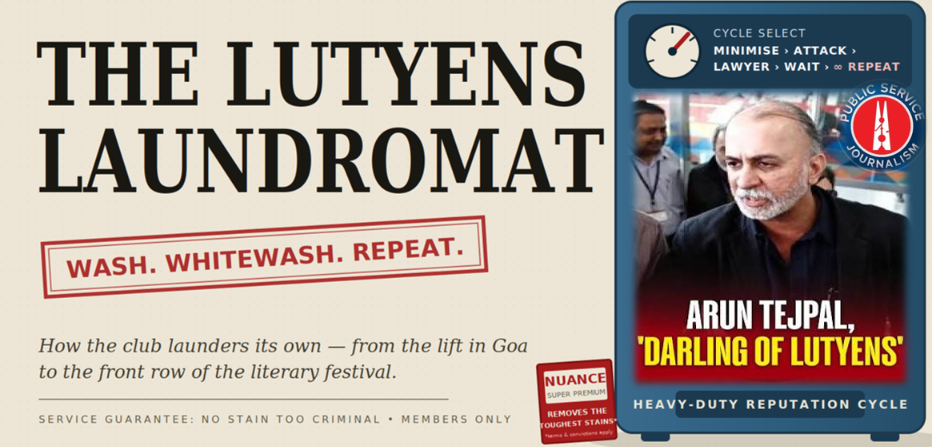
Thirteen years. That is how long it took the Indian justice system to say what a young woman journalist said in November 2013 – that Tarun Tejpal, the swashbuckling conscience-keeper of Indian journalism, founder-editor of Tehelka, the man who lectured the nation on morality between sips of single malt at his own ThinkFest, assaulted her in a hotel lift in Goa. Twice.
There is a genre of Indian morality tale in which the moralist is the villain; last week it got its ending. The Goa bench of the Bombay High Court set aside Tejpal’s 2021 acquittal and convicted India’s self-anointed conscience and patron saint of the panel discussion of raping a junior colleague at his own festival. Ten years’ rigorous imprisonment. A fine. Two weeks to surrender.
His response was a masterclass in self-regard: an appeal to the Supreme Court, and a reminder that he is 62 and a father of two daughters – a credential filed in the same drawer as his famous email confessing a “bad lapse of judgment” and awarding himself a six-month “penance”. Judge, jury and parole board – all in one inbox. Efficiency, thy name is Lutyens.
The woman he assaulted – called a liar for thirteen years by Delhi’s most decorated drawing rooms – now waits to learn how much more suffering the “appeal” holds.
The Original Sin, and the Original Spin
Recall 2013 and marvel at the sainthood. The survivor did everything the rulebook demands: she complained internally. Within days, Tejpal had investigated himself, prosecuted himself, convicted himself of “an awful misreading of the situation,” and sentenced himself to a sabbatical – terms and conditions drafted by the accused.
And what did Tehelka’s managing editor Shoma Chaudhury famously pronounce it? An “internal matter.” Atonement, we were assured, had been “done” – because in this ecosystem, rape is apparently a parking ticket you settle at the front desk. It took public fury and a Suo motu FIR by the Goa Police for the “internal matter” to become what it always was: a crime.
Then came the 2021 acquittal – a judgment so preoccupied with how a rape survivor ought to behave that the Bombay High Court itself remarked it read like a “manual for rape victims.” The Goa government appealed, citing stereotypes and “perverse findings.” In 2026, the High Court agreed. The vindication is the survivor’s. The shame belongs to everyone who spent thirteen years manufacturing doubt on her behalf.
Friends in All the Right Drawing Rooms
Tejpal was never merely an editor. He was an institution of the establishment that ruled Delhi’s drawing rooms – feted by the Congress-era elite, his ThinkFest a red carpet where politicians, corporates and celebrities came to be photographed thinking, his magazine garlanded by the very establishment it theatrically claimed to terrorise.
It has long been alleged – including by a former Tehelka journalist – that a 2004 interview damaging to Rahul Gandhi was spiked after calls from Congress leaders, reclassified from “interview” to “sting” and quietly buried. Tejpal has never been convicted of journalism-by-favour; but then, until last week, he hadn’t been convicted of anything.
The point is not one phone call. The point is the architecture. When your festivals are funded by power, your access is granted by power and your awards are pinned on by power, you are not speaking truth to power – you are power’s in-house theatre troupe. Power expects a return on investment. In November 2013, the invoice came due.
The Choreography
Watch the routine, rehearsed and repeated whenever a club member is caught.
Step one – Minimise. It’s an “internal matter.” A “misreading of the situation.” Boys will be editors.
Step two – Attack the survivor. Months after the assault, an open letter was actually published sneering at the victim as a “bubblegum feminist” fussing over a “small occurrence.” Read that again. A young woman reports rape by the most powerful editor in the country, and the commentariat’s contribution is to grade her feminism. This was not a fringe troll. This was the prize-winning, panel-discussion class – the same people who deliver sermons on “rape culture” whenever the accused is politically convenient. When the accused summers with them, rape culture becomes rape nuance.
Step three – Lawyer the language. Suddenly the confession email “was taken out of context.” The apology “was extracted.” The lift had no camera, so nothing happened; the lobby had a camera, so everything is doubtful. The 2021 trial verdict duly obliged – absorbed with how the survivor texted, how she smiled, how insufficiently shattered she appeared. Last week the High Court answered: her testimony needed no corroboration; his own apology emails were admissions of guilt.
Step four – Wait. Public memory is short; literary festivals are eternal. Let the outrage cool, then ease the man back – a book here, a glowing review there, a discreet seat at the high table – until the pariah becomes a “controversial figure,” then a “complex figure,” then simply a “figure,” laundered into polite society with the survivor airbrushed out of the story.
It has worked before, for every “good” sexual offender. Remember Hasan Suroor, the Indian-origin journalist in the UK accused of paedophilia, solemnly agonised over by Outlook? The same choreography played out for R. K. Pachauri of TERI, David Davidar of Penguin, and Brajesh Pandey – Bihar Congress leader and brother of that celebrated keeper of public morality, Ravish Kumar.
That is the real scandal: not one man’s crime, but an entire ecosystem’s willingness to serve as his laundry service – voices that (rightly) demand accountability when the accused wears a different political colour, yet discover, for their own, an exquisite appreciation of due process and nuance, virtues they misplace the moment the headline suits them.
Remember Who Stood Where
Here is the simple truth this cabal cannot spin away: a junior colleague stood alone against the most connected editor in India, his political patrons, a commentariat that mocked her, and a trial verdict that put her conduct on trial – and she won. Not because the ecosystem lifted a finger for her, but despite every manicured finger being lifted against her.
Some old defenders have, thirteen years too late, located their consciences. Others still mutter about “political vendetta” – Tejpal’s own preferred defence, as if the Bombay High Court moonlights as a party office. Two judges, thirteen years of record, CCTV, emails, testimony – all, apparently, a conspiracy. When the facts convict your friend, indict the facts.
So, the next time this crowd mounts its high horse to lecture the country on misogyny, remember the lift in Goa. Remember “internal matter.” Remember “bubblegum feminist.”
And remember, precisely, who stood where.


Leave a Reply