
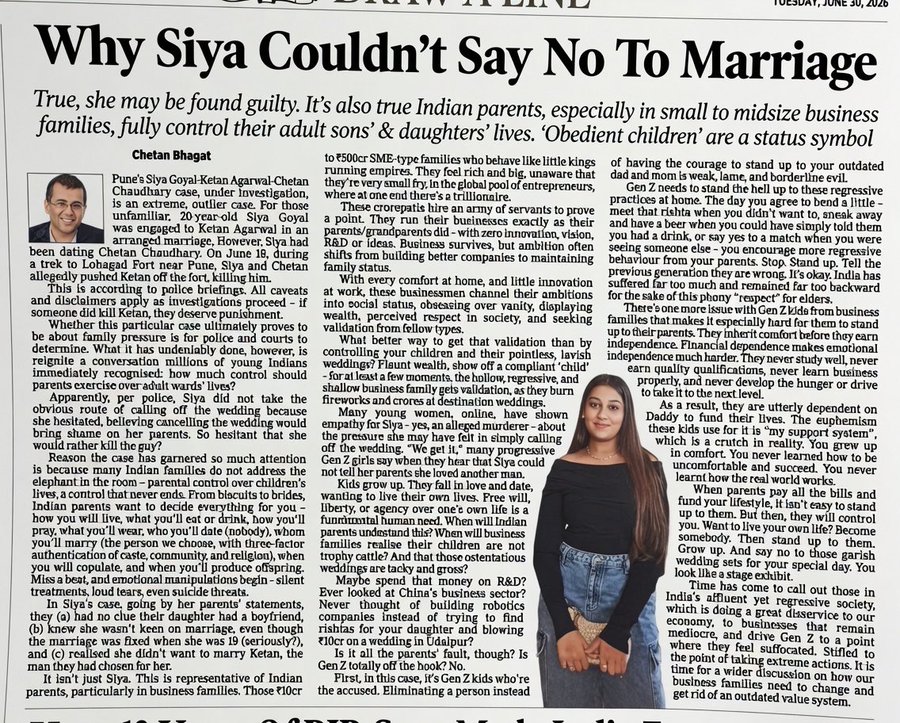
Chetan Bhagat looked at a fort, a fiance, a 400-foot drop, and 2,000 phone calls of planning – and decided the real victim here is the Indian arranged marriage system. Bravo!
But that’s Bhagat. He does that in the celebration of being a celebrity; Bhagat frequently does that. This time, he managed to turn a dead man on the road into a column about the issues with ball bearings.
First, a disclaimer. By writing “the case is still under investigation and that he isn’t trying to give an opinion on it,” he attempts to weld a steel frame at his rear. Then he spends the next 1,400 words doing exactly that – describing Siya Goyal’s feelings as if he was standing right next to her at the fort. You can’t say “I won’t comment on this” and then comment on it for a page and a half. That’s not balance. That’s a disclaimer used as a shield, so he can say whatever he wants and still claim he never really said it.
Now to the biggest problem with his argument. Bhagat says Siya “hesitated” to call off the wedding because cancelling it would shame her parents. So shy of shame, apparently, that the easier option she chose was murder. Stop and think about that for a second. Police say she and Chetan Chaudhary made over 2,000 calls across roughly 238 hours in six months. They also say she had allegedly tried to kill Ketan once before, at an earlier point. That is not a girl who panicked and froze. That is someone who planned, for months. You don’t “accidentally” end up planning a murder the way you accidentally skip a wedding. If she had the nerve and the time to plan a fake accident, she clearly had enough nerve to send one text saying the wedding is off. The “shame” theory doesn’t explain what she did. It’s just a softer word for “premeditation,” laundered through the passive voice, dressed up to sound sad instead of calculated.
And here’s the part Bhagat’s column leaves out completely, which is the part that actually matters: reports say she took close to ₹1 crore from Ketan for wedding shopping and gave it to Chetan Chaudhary to fund his career. That is not a small detail to skip. A column about a “trapped, suffocated girl” has no room for “she also allegedly took her fiance’s money and gave it to her boyfriend,” because that fact ruins the story Chetan wants to narrate. You can write sympathetically about a cornered 20-year-old. Or you can write about someone accused of financially cheating the man she later had killed. You cannot honestly do both at once.
Bhagat also wants this both ways in a bigger sense. He calls this an “extreme, outlier case” in one line, and then says it’s “representative of Indian parents even today” two paragraphs later. Pick one, moron. An outlier means it’s not typical – that’s the whole point of the word. But he needs it to sound extreme enough that nobody can accuse him of excusing murder, but typical enough to justify 1,200 words about family businesses and sanitary tile factories. That’s not a small contradiction. It’s the whole foundation of his piece, and it doesn’t hold.
This brings us to what the column is actually about. It isn’t really about Siya at all. It’s the same column Bhagat has written for years – strict Indian parents, boring family businesses, kids who won’t “stand up for themselves” – and a murder just gave him a fresh headline to hang it on. He even drifts off into talking about Elon Musk and robotics companies. Someone who genuinely cared about the ethics of this case wouldn’t spend a third of the article wondering why Pune hasn’t built the next big tech company. He’s using the dead-bodyas a springboard and calls it social commentary.
Now notice the one line he almost apologizes for including. He writes that if the accusations are true, “eliminating a person… is weak, lame, and borderline evil.” Look at those words – “weak” and “lame.” That’s the language you’d use for someone who quit a gym membership, not for someone accused of a cold blooded murder. Compare that to what Shiv Aroor said, plainly and without any detour into wedding budgets: “Siya Goyal is a soulless psycho… No amount of context justifies what she did.” One sentence. No hedging. No Elon Musk reference. That’s the difference between calling a crime what it is and quietly whitewashing it to peddle your own lost commentary.
Here’s a simple test that breaks Bhagat’s whole argument. Imagine the genders were reversed – a 26-year-old groom pushes his fiancee off a fort to fund his girlfriend’s career. Nobody, including Bhagat, would write a gentle column about how his parents failed to notice he liked a drink. He’d be called a monster, plain and simple, no talk of “free will” needed. The only thing that changed this from a crime story into a coming-of-age essay is that the accused is young, attractive, and a woman. That isn’t kindness or progress. It’s a double standard, just dressed up to look thoughtful.
None of this requires defending Ketan Agarwal’s family, or pretending Indian arranged marriages are a utopia of consent. But it has worked well so far, with exceptions – and that conversation is worth having – on its own merits, not as a character defense for someone accused of premeditated murder and financial fraud.
Siya Goyal doesn’t need a sociologist. She needs a verdict. Bhagat, evidently, needed a column.


Leave a Reply