On 4,399 Days, a Nation Reborn, and the Audacity of Delivery
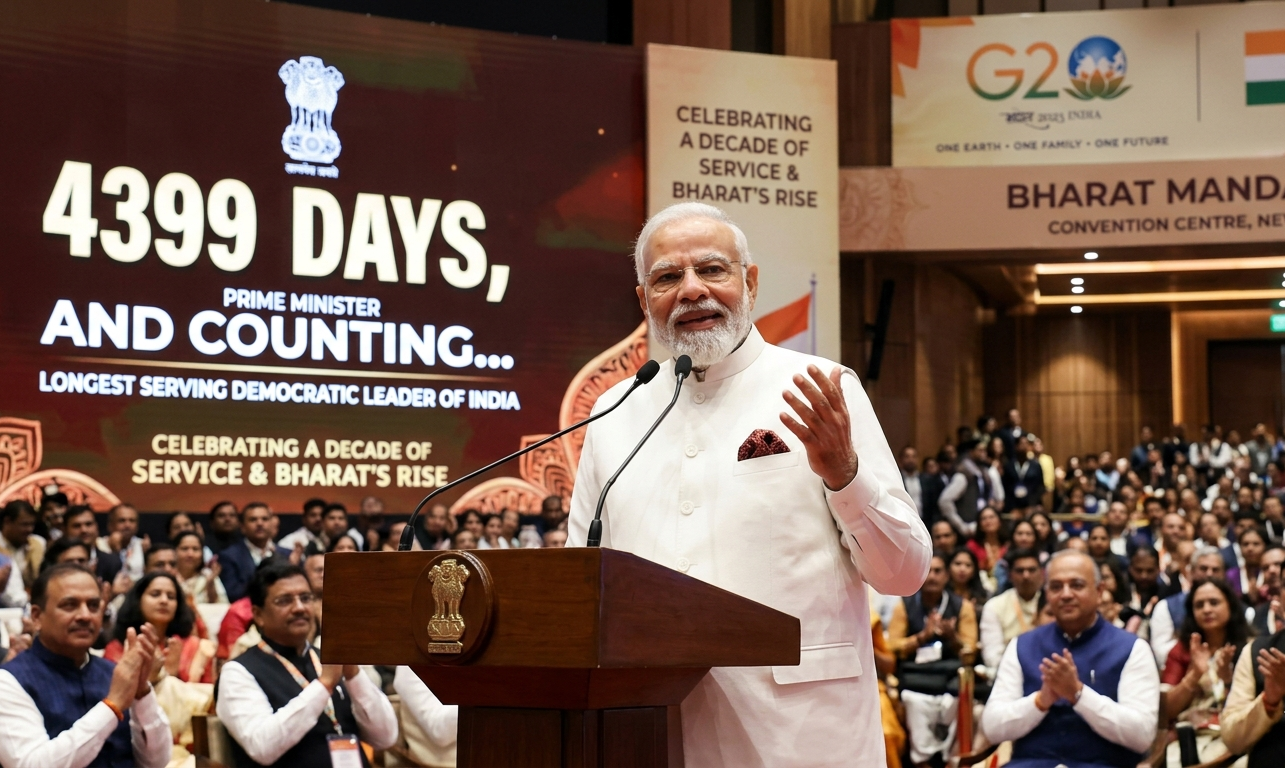
On June 10, 2026, Narendra Damodardas Modi crossed a threshold that no elected Prime Minister of India had crossed before him – 4,399 consecutive days in office, surpassing the record held by India’s first Prime Minister, Jawaharlal Nehru, by a single, rather poetic day. One day. As if it is stopping here… for a sense of humour.
It is worth pausing here to appreciate the symmetry, and the irony. Nehru, the patrician architect of modern India, the Harrow-educated, Fabian-inclined dreamer who governed from 1952 to 1964 with the serene confidence of a man who knew Sanskrit and had read Proust, is now, officially, second. And the man who displaced him once sold tea near a railway station in Vadnagar, Gujarat. You genuinely could not write this.
But this piece is not about origins, however cinematic they may be. It is about what twelve years, and counting, of uninterrupted governance has meant for a country of 1.4 billion people, and why the world has taken notice in ways that would have seemed fanciful not so long ago.
The Architecture of Delivery
When Modi took office in 2014 with a thundering parliamentary majority, India was a country that had grown accustomed to governance as a promise deferred. Welfare schemes were elaborate ceremonies, money moved through systems that ensured it arrived diminished, and infrastructure was something that happened in press conferences.
What followed over the next decade-plus was a systematic dismantling of that inheritance. The Jan Dhan–Aadhaar–Mobile trinity created a direct-benefit architecture that quietly bypassed the middlemen who had, for generations, been the most reliably prosperous participants in India’s welfare story. Over 500 million bank accounts were opened, linking citizens to subsidy pipelines that actually flowed. The Jal Jeevan Mission brought piped water to rural households that had waited since 1947, which, coincidentally, is around the time the previous era of leadership was getting started. The Pradhan Mantri Awas Yojana put roofs over millions of heads, and 81 crore people received free food grain through a welfare net that held even through the turbulence of a once-in-a-century pandemic.
Then there is the infrastructure — the kind you can see and, more importantly, use. The Vande Bharat trains, which run on time with an enthusiasm that would surprise anyone who grew up taking Indian Railways for granted. The Namo Bharat RRTS. The Kashmir rail link, which connected a valley to the mainland in ways that diplomats had struggled to do for decades. INS Vikrant, India’s first domestically built aircraft carrier. The new Parliament building. Kartavya Path, where India now celebrates itself without apology.
These are not small things. These are civilisational statements made in concrete and steel.
The New India Abroad
Perhaps the most consequential shift of the Modi years, though, is not something you can commission a contractor to build. It is the recalibration of India’s self-image and, by extension, the world’s image of India.
For much of its post-independence history, India conducted itself on the global stage with a combination of moral authority and material hesitancy, very loud on non-alignment, somewhat quieter when it came to projecting hard interest. The Ministry of External Affairs today describes the past twelve years as a “remarkable transformation” in Indian foreign policy, and for once, ministry language does not seem like an overstatement.
India is now the fourth-largest economy in the world, having overtaken Britain and Japan, both of whom were, at various points in history, in a position to dictate terms to this subcontinent. The G20 Presidency of 2023, held in New Delhi, was not merely a logistical achievement; it was a signal, delivered in the language of summits and communiqués, that India had stopped waiting for a seat at the table and had, in fact, started setting it.
The International Solar Alliance, the Digital Public Infrastructure exported through UPI’s global expansion, the role as the consistent voice of the Global South – these are the instruments of a country that has graduated from being merely large to being genuinely consequential. Papua New Guinea’s Prime Minister called Modi “a role model and an example of leadership.” The US Senate’s India Caucus co-chair described his tenure as “nothing short of transformational,” crediting him with lifting 250 million people out of poverty. Malaysia, Australia, Trinidad and Tobago — congratulations poured in from across the world on June 10, not as diplomatic courtesy, but as recognition of a leader whose footprint on global affairs is now undeniable.
The Approval That Doesn’t Fit the Narrative
There is a particular kind of discomfort in certain circles when the Morning Consult Global Leader Approval ratings are published. Month after month, year after year, Narendra Modi sits at the top. 75% approval in July 2025, 68% in March 2026, while leaders of the world’s largest democracies and most celebrated economies trail at numbers that would embarrass a mid-tier municipal councillor. Emmanuel Macron at 17%. Keir Starmer at 24%. Donald Trump, the most covered political figure on earth, at 39%. Modi: first, by a comfortable distance, for years on end.
This is not the metric of a man who has merely survived. This is the arithmetic of a leader who has consistently, across three electoral mandates and twelve years of governing, persuaded the people he governs that the arrangement is working in their favour. Three consecutive Lok Sabha victories, only the second leader in Indian history to achieve this, this time each earned through the ballot box in a functioning, fiercely contested democracy.
The Civilizational Frequency
There is a dimension to the Modi decade that resists the usual policy vocabulary. India has begun, quietly but unmistakably, to rediscover its civilizational confidence – the sense that it is not merely a developing nation racing to catch up with Western benchmarks, but a civilizational state with its own deep grammar of philosophy, architecture, science and governance.
The consecration of the Ram Mandir in Ayodhya was, whatever one’s political prism, a moment that carried enormous emotional weight for hundreds of millions of people who had waited lifetimes for it. Chandrayaan-3’s landing near the Moon’s south pole in 2023, a first in human history, was celebrated not just as a technological triumph but as proof of a country that dreams at scale and delivers. India’s non-fossil fuel energy sources now account for over 50% of installed energy capacity – among the first major nations globally to reach that mark, announced not with the anxious hedging of a country seeking validation, but with the assurance of one that knows its own direction.
And Then There Was Nehru
It would be remiss not to acknowledge the man whose record has just been surpassed. Jawaharlal Nehru served India from independence in 1947 until his death in 1964, and his contributions to the Republic, the democratic institutions, the IITs, the constitutional architecture, all deserve their due. He was, unquestionably, a man of vision.
It is just that some of that vision, the industrial policy that treated markets with aristocratic suspicion, the foreign policy that deployed high-minded neutrality in places where national interest might have served better, the Fabian socialism that built a licence raj so impenetrable it would take five decades and multiple reform cycles to dismantle – was the kind of vision that sometimes sees everything except what is directly in front of it.
Nehru, famously, governed a newly free nation from Delhi’s majestic bungalows, surrounded by intellectuals and ideas. Modi arrived from the dust of a small town, having governed a small state for thirteen years before he got to Delhi. The contrast is not merely biographical. It is the difference between politics as inheritance and politics as craft. The difference is between governing as an expression of who one is and governing as an expression of what one must do.
India, evidently, has found the latter more useful.
4,399 Days, and Counting
On the day this record is being crossed, the ruling alliance gathered in New Delhi. Congratulations arrived from across the globe. A man who had spent his early years in the RSS Shakhas of Gujarat had now, through electoral mandate, uninterrupted service, and the grinding daily work of governance, written himself into Indian history in a way that will be difficult to dislodge.
History, of course, will render its own verdict in due time. Records are footnotes; legacies are chapters. But if you are reading this in 2026 and wondering what twelve years of Narendra Modi as Prime Minister has meant, the short answer is this: India is the world’s fourth-largest economy, its citizens have bank accounts and toilets and tap water and Vande Bharat trains, its foreign policy has a backbone, its space programme lands where no one else has, and its Prime Minister is the most popular elected leader on the planet.
Whatever one thinks of the man, that is not nothing.
That is, in fact, beyond imagination.


Leave a Reply