
Technology, in a recent commentary by Sanjeev Sanyal, is more than gears and code – it is a levelling force that enables ordinary people to achieve what was once reserved for experts. Citing historical examples like peasants bearing muskets against highly organized Mongol archers or the disruption of the Indian textile industry by industrial looms, he drives home his argument: technology extends the frontier of excellence for ‘everyone and not just a privileged few.’
The century ahead can indeed be an ‘Age of India,’ and shaped by this very technological paradigm – but only if we ensure sovereignty. For technology to empower Indians without increasing dependence on foreign tech giants, we must develop and adopt AI that is indigenous, attuned to our culture, and managed within our borders.
The Elite AI Myth
The current global discourse surrounding AI is primarily focused on a ‘scarcity and risk’ narrative – one where AI is predominantly treated as an instrument for the cognition elite – the researcher from an Ivy League school or the coder from Silicon Valley. But in the context of India, the true destiny of AI is ‘Massification.’
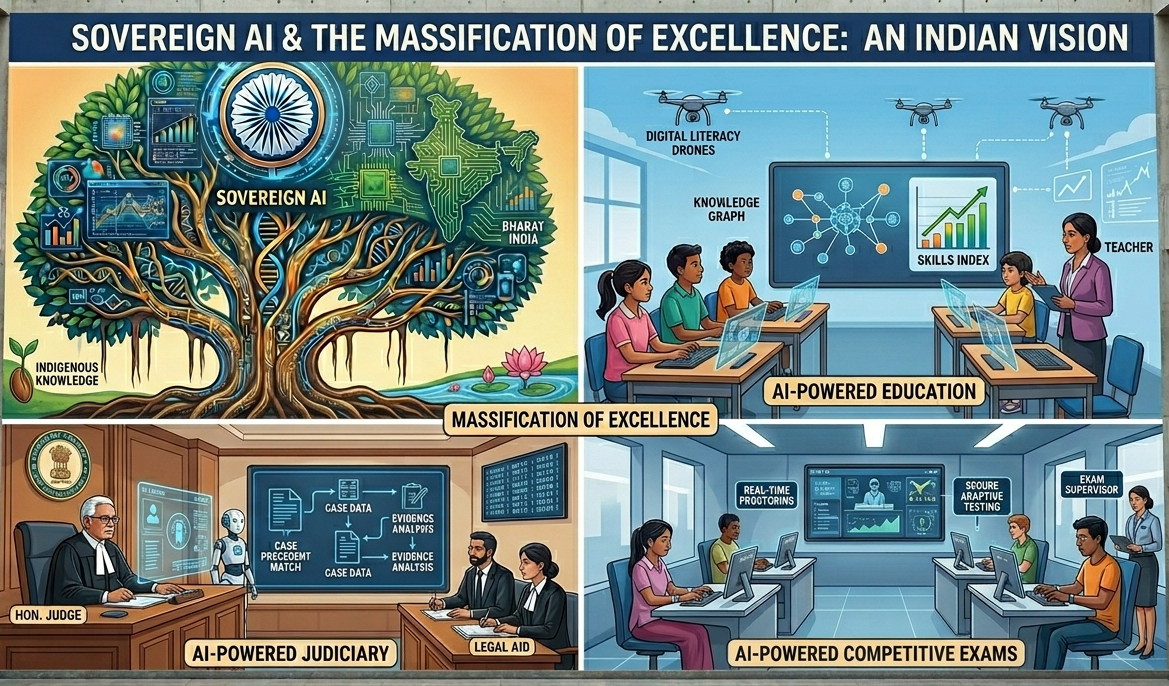
Much like how the unskilled English peasant outcompeted a master Indian weaver because of the Industrial Revolution’s technological advantage, the Agentic AI will enable an Indian paralegal to match the performance of a senior advocate and a sub-urban Indian teacher to impart education equivalent to an elite international academy. It is less about efficiency and more about breaking the ‘gatekeeping of excellence.’
Judicial Democratization: Farewell to Case-File Overload
Arguably the most pertinent illustration of Sanjeev’s ‘high-skill barrier’ is India’s judiciary. For the time being, the understanding of millions of case files spanning decades and the thousands of pages of legal precedent are skills reserved for a microscopic elite comprising of senior advocates aided by thousands of assistants. This inherently creates a bottleneck, leaving justice delayed for millions.
By deploying sovereign Agentic AI, we are not replacing judges or lawyers. Instead, it will equip both the junior lawyer and the individual litigant with the ‘musket.’ An AI agent that can condense a 5,000-page document into a three-page summary in a matter of seconds is not an ‘assistant’; it is the ultimate leveller, providing a first-generation lawyer from a small town the same analytical preparation in a High Court that a third-generation legal luminary may possess. It’s the ‘nature of technology’ at play, minimizing the ‘skill tax’ levied on justice.
Education: From Waterfall to Sovereign Stream
Sanjeev suggests shifting the current ‘waterfall’ model of education – where one has to front-load a vast array of knowledge for decades that might become obsolete, toward an iterative, lifelong ‘stream.’
In India, the challenge is scale. We simply cannot build physical ‘centres of excellence’ in the rapid time required to support the demographic dividend. The solution to this problem is the ‘AI-Native Campus.’ Integrating sovereign AI into the very foundation of our universities, we transition from a teacher-led model of scarcity to a platform-led paradigm of abundance.
When a rural student has access to a ‘Mastery Engine’ – a sovereign AI tutor that understands their mother tongue (local dialect), their cultural nuances, and can adapt its approach to suit their learning pace, geographical and economic barriers to ‘high-skill’ learning evaporate. Crucially, this must be a Sovereign Learning Operating System. Otherwise, as our students’ cognitive data and the intellectual property embedded within their education gets stored in foreign servers, we are not democratizing technology; we are outsourcing our intelligence.
The Necessity of the Sovereign Stack
But what makes sovereignty imperative for massification? Sanjeev’s historical examples offer the explanation. The Indian textile industry didn’t just lose to the ‘ease’ of the power loom; it lost because the technology was controlled by a colonial power that dictated the terms of trade.
In the Age of AI, data is the new raw material. If India continues to rely on ‘Black Box’ models from international tech giants, we are not just increasing our dependence; we are inviting a new kind of digital feudalism. A sovereign AI stack ensures:
Data locality: India’s sensitive data (case files, students’ learning patterns etc.) will remain under Indian jurisdiction.
Contextuality: A global AI might know “law” but may not understand the cultural context or nuances of the Bharatiya Nyaya Sanhita and the complexities of a village panchayat. Sovereign AI can be fine-tuned on India’s own realities.
Strategic Autonomy: The ‘muskets’ of our nation cannot be remotely disabled or outpriced by external powers.
The Indian ‘Musketeer’
While the disruptive capabilities of AI are often associated with job loss, when viewed through the prism of Sanjeev’s perspective, it poses a threat only to the monopoly on skills.
India’s future does not depend on shielding old job descriptions, but rather on equipping its billion-plus workforce with the most sophisticated technological tools in existence. The day when ‘less-skilled’ individuals produce ‘high-skill’ outcomes, the entire country’s productivity shifts upward. By creating sovereign AI infrastructure, we are not simply observing the global trend toward democratization that Sanjeev describes; we are actively shaping and owning it at home. We are headed toward an India where excellence is not the privilege of a select few but the access of everyone – a common utility. This is the true essence of technology and our path to a developed India.


Leave a comment