
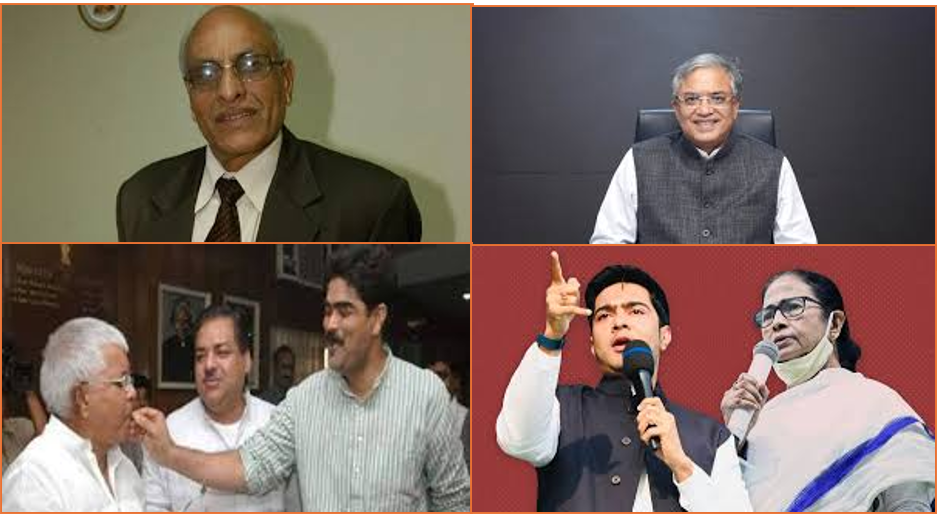
The history of Indian democracy is often written in the ink of the common man’s thumb, but occasionally, that ink is protected by the steel of institutional resolve. Two specific chapters – the 2005 Bihar Assembly election and the 2026 West Bengal Assembly election – stand as mirrors of each other. Separated by two decades, these elections represent moments where the “science of rigging” was dismantled by the sheer grit of the Election Commission (EC). In both instances, fierce, independent leadership transformed a climate of fear into a festival of the franchise, proving that no “Jungle Raj” or “Syndicate” is more powerful than a free and fair vote.
The Architects of Democracy
In 2005, the architect of change was KJ Rao, whose “Bihar Model” became the gold standard for conducting polls in conflict-prone zones. He faced a state machinery that had been subservient to a single ruling dispensation- Lalu Prasad Yadav’s fiefdom, for fifteen years.
Fast forward to 2026, and Chief Election Commissioner Gyanesh Kumar has emerged as the modern custodian of this legacy in West Bengal. Under Kumar’s stewardship, the EC orchestrated a “return of the formal state,” mirroring the institutional grit Rao displayed in Bihar. Both leaders recognized a fundamental truth: democracy cannot breathe if the state machinery is used as an oxygen mask for a specific ruling party.
Dismantling “Ghost” Infrastructure
The first and perhaps most critical similarity between these two elections was the mechanical dismantling of the “Ghost Voter” infrastructure through Special Intensive Revision (SIR).
In Bihar (2005), KJ Rao initiated a massive purge of voter lists, removing hundreds of thousands of fictitious names used by party goons to cast bogus votes. In Bengal (2026), the scale of the purge under Gyanesh Kumar was unprecedented, resulting in the removal of nearly 91 lakh names from the electoral rolls. This targeted fake voters, deceased individuals, relocated persons, and “Logical Discrepancies” like double enrolments.
By removing this artificial padding, the EC dissolved the “safety net” that bridged the gap between victory and defeat for incumbents. In Bengal, this was bolstered by 19 special tribunals and Supreme Court oversight, ensuring that local political actors could no longer manipulate Booth Level Officers (BLOs).
Breaking the Back of Institutionalized Violence
Both Rao and Kumar understood that a free vote was impossible as long as a “politicized bureaucracy” remained in place. Historically, District Magistrates (DMs) and Superintendents of Police (SPs) in these states often acted as extended arms of the party in power.
The 2005 Overhaul: Rao mandated the transfer of nearly every key officer who had served in a single district for more than three years. By placing external observers in every constituency, he ensured that local administration could no longer provide “tacit approval” for booth capturing.
The 2026 Strategy: Recognizing that “strongmen” and “syndicates” often co-opted the state machinery, the EC enforced an equally strict strategy in West Bengal. Local administrative officials were either transferred or relieved from duty to ensure they did not assist the ruling party’s interests. This effectively sidelined informal power structures, allowing neutral institutional governance to take center stage.
The most visible similarity was the strategic deployment of Central Forces to neutralize the “fear factor”.
Historically defined by “Bahubalis” (strongmen) who seized polling stations, Bihar’s “Jungle Raj” was characterized by a collapse of law and order and systemic extortion. Under Rao, the state police were moved away from booths. Armed central personnel verified IDs at three separate checkpoints, ending “bulk voting” where a single strongman would vote for an entire village. In strongholds like Siwan, Rao’s team implemented a total lockdown, positioning forces inside booths and patrolling the hinterlands to erase fear. When reports of rigging emerged in pockets like Chhapra and Madhepura, the administration immediately ordered re-polls and disqualified booths, signalling that the state would no longer look the other way.
The 2026 election broke a five-decade legacy of violence. Heavy deployment of central forces was utilized for active patrolling and “parades” across the state. This ensured that ruling party strongmen were unable to prevent opposition voters from reaching booths. When rigging was attempted in sensitive districts – including areas like Falta and Diamond Harbour, the EC responded with immediate re-polls and disqualifications.
The Surge of the “Silent Voter”
These institutional corrections led to the same result in both states: the emergence of the “Silent Voter”. In Bihar, women and marginalized groups who had been intimidated into staying home emerged in record numbers. The political landscape underwent a tectonic shift, reflecting a public desire for Vikas (development) and Sushasan (good governance) over identity-based slogans.
Similarly, in Bengal, the absence of violence indicated a genuine surge of the silent majority. The first phase saw a record-breaking 92.9% turnout, the highest since independence, a trend that repeated in the second phase. This historic participation rate fundamentally altered the state’s political math.
A deeper nuance shared by both elections was underlying economic frustration. Just as Bihar sought to escape the stagnation of “Jungle Raj,” Bengal in 2026 sought to move past a system where “syndicates” interfered with everyday life and job creation. The youth desired facilities similar to those in Bengaluru or Delhi, and the Election Commission provided the secure environment necessary for that aspiration to be recorded at the EVM.
Restoration of Democracy
If the 2005 Bihar election proved that an independent EC could dismantle an entrenched system of misrule, the 2026 West Bengal election has reaffirmed this truth for a new generation. By ensuring “Ghost Voters” vanished and the “Fear Factor” was erased, Gyanesh Kumar followed the KJ Rao model to its logical conclusion.
These watershed polls were not merely about counting votes; they were about witnessing the return of the people’s sovereign choice. When the institutional shield was raised, the people’s mandate finally prevailed over the “science of rigging”. If 2005 was an election of survival, 2026 has become the election of correction.


Leave a comment