The business end of the 2024 General Elections is over. 486 (90%) parliamentary constituencies have already voted. 28 states have fully completed their voting process. Before Himachal, Punjab, Chandigarh and the remaining seats of Bihar, Jharkhand, Bengal, Orissa, and Uttar Pradesh go for the final phase (57 seats), India has already given the verdict of 2024 and only the enormity of the verdict is left to be decided.
In the last 10 years after having predicted more than 20 Indian elections accurately including the Pre-Poll Prediction in the 2014 [275 Plus for BJP] and 2019 [300 Plus for BJP and 350 Plus for NDA] Lok Sabha Elections, that too without large samples, or simulations using predictive algorithms, every time I had put my neck out to call the elections with a fair degree of certainty. Every time it was bang on target.
I must admit that on two occasions, my predicted numbers were far off. The 2015 Bihar Assembly Election prediction was made much before the election started, and the last-minute false narrative twisted around a falsehood (Mohan Bhagwat’s statement on reservation) made the whole equation shift in favour of the Mahagathbandhan. I conceded the mistiming. The second was the 2021 West Bengal Assembly Elections. However, there was a rider in predicting the Bengal elections – ‘if there happens a free and fair election.’ The mood of Bengal was well read, which has only gone stronger in favour of BJP since 2019. But in Bengal, only public mood and support do not make you win the election but are fought on the ground – to mobilize supporters, keep them under a safety net, ensure they reach the polling booth and cast their votes. And we all know, what happened in 2021.
Barring those two occasions, I have called out elections very clearly and much more confidently than many elite psephologists. All that without being on ground zero, or a network of data collectors or modern tools of simulations and algorithms. At the bottom of this piece, I have shared links to those published predictions, just in case anyone wishes a verification. Some examples here…
Various organisations/agencies conducted opinion polls to predict voter intentions in the 2017 Uttar Pradesh legislative assembly elections. Not a single mainstream agency had predicted BJP to cross 250 against Mayawati’s BSP, and a formidable SP+Cong alliance. The Poll-of-Poll numbers were off by 50%.
Forget the Opinion Poll, even their exit poll numbers were as far off as 200 against the actual 312. Only Today’s Chanakya had called the election right.
| Polling org./agency | BSP | BJP | SP + INC | Others |
| VMR | 64 | 200 | 120 | 19 |
| MRC | 90 | 185 | 120 | 8 |
| Today’s Chanakya | 27 | 285 | 88 | 3 |
| AXIS | 35 | 265 | 100 | 3 |
| Cvoter | 87 | 161 | 141 | 14 |
| Gramener | 67 | 193 | 133 | 10 |
| India TV Forecast | 87 | 161 | 141 | 14 |
| ABP News – CSDS | 63 | 174 | 164 | 2 |
| Polls average | 65 | 203 | 126 | 9 |
It was almost funny to receive responses after I predicted the BJP to win an almost three-fourths majority in 2017. This was my conclusion:
Link: the-bjp-could-spring-a-surprise-in-uttar-pradesh
In another hilarious incident, this spontaneous response to a TV debate on Twitter based on my published research of the 2019 General Elections garnered funny responses on result day.
The result: BJP won 62 seats; Congress won 1.
Having said that, it is time to call out the 2024 election once again with certainty. I have already covered all the states in detail on MyIndMakers predicting BJP to reach above 340 and NDA to cross 400 seats. In this piece, I will also be considering events during the election, and all the important aspects leading to the final prediction.
THE INCUMBENT:
Prime Minister Modi’s popularity is still at its highest and is only growing. The relationship of such a popular leader with voters is not just transactional but highly emotional. There is a very emotional pro-incumbency in the female electorate for PM Modi’s welfare schemes. PM Modi is looked upon as India’s first civilizational PM. His position on nationalism, anti-corruption, and no-nonsense approach to civilizational issues like Ram Mandir, is culminating in yet another tsunami of support.
THE OPPOSITION:
The other side is filled with confusion, chaos, and deceit. Before the election even started, the I.N.D.I. Alliance displayed that they are an alliance of compulsion. Zero cohesiveness, they were seen pulling each other down, fighting on seat-sharing issues, without any consensus on the leadership or Prime Ministerial face. Nothing positive except a hope that the arithmetic would work.
Given the friendly pitch, the BJP ensured that Rahul Gandhi remained the main opposition face and continued its campaign around him. Rahul being Rahul, yet again presented ideas that were utterly negative and dangerous for the country. The main alternative ideas that were presented were – caste census, Jitni Aabadi Utna Haque, Scanning the Wealth of Communities, wealth re-distribution, etc. None of these stick to the consciousness of the aspirational Indian electorate today. They are also very easy to neutralise, as there are countless examples that wherever in the world such ideas have been attempted only mass economic devastation and social unrest have been the outcome.
Rahul and other opposition leaders also displayed disdain for Sanatan which began with rejecting the invite of Ram Temple consecration at Ayodhya.
CAMPAIGN AND ELECTORAL STRATEGIES:
PM Modi set the tone of this with the call for 400 seats for NDA. The entire agenda of electoral engineering, thus, changed. From “Will Modi-led BJP form Govt for 3rd term”, the narrative shifted to the enormity of the win to “Abki Baar 400 Paar”!
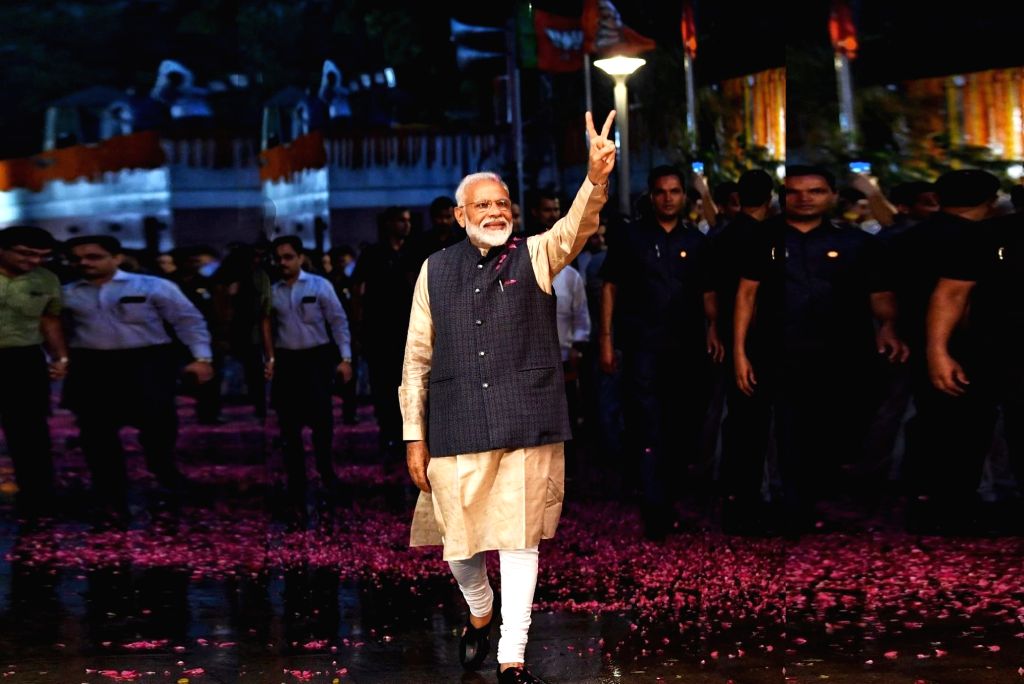
BJP’s campaign was pitch-perfect. There’s no doubt that PM Modi is the greatest election campaigner ever in India. His rockstar-kind roadshows and gargantuan public rallies get frenzy-level support. If that was not enough the series of countless interviews made his views reach every household every day and helped the campaign rise at the right time that peaked at the best time.
We witness PM Modi working overtime, while the traditional campaign also continued at the ground. Thousands of meetings by all the star BJP leaders, 24×7 spokespersons on TV channels, social media influencers, volunteer campaigns like ModiOnceMore2024 and a sea of supporters with WhatsApp on their smartphones are the mainstay of BJP’s organic rise over the last ten years.
On the other hand, the main election pitch of the opposition revolved around the ‘death of democracy’ and ‘changing the constitution,’ to propagate the falsehood that the Modi Govt will stop the reservation to SCs, STs, and OBCs. This was in no way going to stick to BJP having an OBC Prime Minister. If they had to, they would have done it in previous terms. It only handed a weapon to the BJP. Having tasted defeat in the 2015 Bihar Assembly election because of this last-minute falsehood, PM Modi countered it with brutality, mixing it with the opposition’s appeasement politics. Neither the opposition nor the elite narrative peddlers could cope with this frontal attack.
If not visiting Ayodhya, his allies calling Sanatan Dengue and Malaria and taking a vow to eradicate Sanatan and Congress maintaining deafening silence was not enough, Rahul Gandhi also came up with the idea of “Hum Jo Hindu Dharm Mein SHAKTI Hai, Us Se Lad Rahe Hain.” Full-toss after full-toss. It is incomprehensible that in the middle of such a do-or-die election, one can mock PM Modi for offering prayers at the submerged city of Dwarka. Only Rahul can.
Rahul Gandhi’s shifting from Amethi to Rae Bareli was not an election strategy, but an exit poll in the middle of an election. Optics is important in elections. The scene in which no senior Congress leader was present in KL Sharma’s nomination only adds to the disappointment in the party cadres.
Amethi and Rai Bareilly show the real pulse of locals and their feelings on being left behind in development by the rule of congress dynasts. A strong anti-incumbency among locals is now a reality. Even if Rahul Gandhi wins from Rae Bareli, at max it could help him and his loyalist that the strategy worked, against the fact that it would still be ONE out of eighty seats in UP.
It will be a shame for Congress if they fail to win Rae Bareli. If there’s a loss from Rae Bareli, it will be very difficult for Rahul to carry on as heir-apparent of Congress, while another set of cadres want Priyanka Gandhi Vadra to lead. What a strategic fiasco!
Referring to strategy, the mind boggles thinking how a seasoned political party can be so stupidly incompetent to realise that Modi’s free-ration scheme is immensely successful, and yet, only after the 4 phases of the election woke up to announce, “10 KG ration to poor if voted to power“! The Khatakhat-Khatakhat approach missed where it was needed the most.
Had that worked? Not necessarily. Competitive welfare works when there is doubt about the intent of the incumbent or there are leakages in the current scheme. The Indian voter prefers clarity, not confusion.
On top of all that, BJP party workers are highly organized. In every polling booth, BJP workers were given a special voter list containing the names of ‘Labharthis’ of the central or state government schemes within their booth area and these workers went and directly sought support from these voters. BJP’s organic reach and rise do not depend on what we see in mainstream media. This is what elite psephologists miss every time.
WORKING NARRATIVE:
As a result of the positive campaign that was riding on the performance of two terms, the main narrative that worked on the ground were – Ram Mandir, Tushteekaran Vs Sanatan, DBT (with zero corruption), Labharthis – (free ration, house, gas, toilet, electricity, Bank account, Ayushman card), National Interest and India’s global positioning, Visible Infrastructure development at unprecedented pace, Suraksha (better law and order), and finally Modi Vs who?
With all their effort or lack of it, the opposition couldn’t set the narrative. Like every other election, they were busy responding to the narrative PM Modi was setting rallies after rallies.
DECIDING SEGMENT:
Women are the main supporters of PM Modi across the country. Women voter plays a critical role in deciding the verdict and are very loyal to those leaders who care for them in time of need. It would not be an exaggeration to say that at least 10-15% of Muslim women are voting for PM Modi defying their men. It is PM Modi’s image of the liberator of Muslim women, that has moved the Indian electorate from Minority veto to Women veto. This phenomenon was also seen in the latest State Elections of MP, Rajasthan and & Chhattisgarh.
The bad news for the opposition is that in the six phases, the women voting percentage is higher than in 2019.
TURNOUT:
The low or high turnout of voters does correlate with the outcome if the composition is well understood. In general, and historically, high turnout indicates anti-incumbency, moderate turnout shows the status quo and low turnout suggests no enthusiasm to oust a government.
The turnout of BJP voters has not decreased. It is the opposition and Congress workers who, observing the certainty of a loss, have stayed away, and are mostly missing from voting leading to lower turnouts. Even on seats that the opposition would win, the margins are going to be touch and go.
GAME CHANGER:
While BJP is maintaining their consolidation in the Hindi heartland, west and northeast, it is also expanding in many states. The ground feedback is suggesting the BJP will emerge as the single largest party in many of these states.
There’s an undercurrent in Odisha in favour of the BJP and a strong anti-incumbency against the state govt. People of Odisha, especially in the rural area, want a change of government in the state and want to see Vikas delivered by PM Modi. BJP is all set to be the dominating party in Odisha and can gain significantly in the state assembly.
BJP is also on the rise in Bengal. Indian society, especially Hindus, tends to be in slumber and react when the threat is alarming. The ugly truth of Sandeshkhali has put the local TMC government to shame. It’s the Singur Moment for Mamata Banerjee…. if the election is held fairly, it’s game over for Mamata Banerjee.
Telangana is another state where the BJP is on a sharp rise it is doubling its vote share election after election. With the dominant BRS facing total collapse, the BJP is in direct contest with Congress. That makes BJP’s path much easier.
If 2014 was all about Modi’s conquest of the Hindi heartland, 2019 was all about its surprise rise in Bengal and the East. 2024 will be defined by its deep penetration in the south. Having covered almost all aspects of this election, the final projections for 2024 are here.
WORST CASE SCENARIO:
From the original prediction that was shared before the start of the election, for BJP alone there may be possible losses of 3-4 seats in Karnataka, 3-4 seats in Rajasthan, and a couple in Haryana. That makes a total loss of 8-10 in these three States. Assume a loss of another 3-5 seats in other states. That brings the BJP down from 303 in 2019 to 290 seats in 2024, which is still above Majority. Now consider a conservative gain in Tamilnadu (3), Bengal (6), Telangana (4), Punjab (2), Kerala (1), Andhra (2), Odisha (5), UP (6). A minimum gain of 30 seats takes it to 320 seats, with certainty.
Now look at the NDA partners. There could be a loss of a few (2-3) seats in Bihar, a few (2-3) in Maharashtra and a couple in Punjab which is a loss of 7-8 seats. Now consider a conservative gain in Andhra (10-12), TN (2-3), Karnataka (2-3), UP (2-3), Northeast (2-3), and others (2-3). These additional 10 seats add up to 60 seats compared to 50 seats in 2019. That makes 380 seats for NDA, a certainty.
Time and again, political pundits have failed to understand that with Narendra Modi’s politics of positivity and delivery, and a clear shift in focus from providing doles to fulfilling public aspirations, the Indian electorates have moved on. For both print and electronic media political pundits, the Modi wave, which was over post-Covid, is returning as a thunderous tsunami. Such a tsunami not only creates unseen destruction but also enters unexpected territories.
This election has all the ingredients to throw the biggest mandate India has ever witnessed thus far.
Few Links to previous published predictions:
- https://swarajyamag.com/politics/why-this-election-is-looking-like-modi-versus-nothing
- https://www.myind.net/Home/viewArticle/lok-sabha-2019-understanding-the-prospects-of-nda-in-the-hindi-heartland-part-1-the-bihar-arithmetic
- https://www.myind.net/Home/viewArticle/lok-sabha-2019-the-prospects-nda-in-the-hindi-heartland-part-2-madhya-pradesh-chhattisgarh-jharkhand
- https://www.myind.net/Home/viewArticle/lok-sabha-2019-the-prospects-of-nda-in-the-hindi-heartland-part-3-delhi-punjab-haryana-hp-and-uttarakhand
- https://www.myind.net/Home/viewArticle/lok-sabha-2019-the-prospects-of-nda-in-the-north-india-uttar-pradesh-can-nda-repeat-2014
- https://www.indiafacts.org.in/narendra-modi-for-2014-an-analysis/


 shwetank's-pad
Leave a reply to Anil Nayak Cancel reply