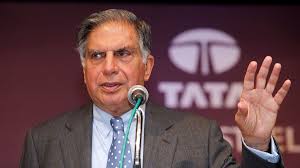
One day a very dear and sharp friend made an interesting observation about Ratan Tata – whose career began with a fight with Rusy Modi and ended with a battle with Cyrus Mistry, the two giant Satraps of the Tata Group.
Interesting, and factual. But what happened in between?
There’s something more. In today’s Information age, Ratan may be a name that holds different meanings for different folks and that is all-natural as his work impacted the lives of every Indian across India and also outside India. But to many post-91 generation kids, he was a visionary who had come to define Indian ambitions, struggles, and success.
Behind a shy, soft-spoken individual, there was a gritty, determined corporate visionary bull. Here begins his story as chairman of Tata Group.
Tata Sons, the initial investor in many Tata companies, eventually became the group holding company. JRD Tata, the son of Jamsetji Tata’s cousin, was elected chairman of Tata Sons in 1938. JRD was the kind of chairman any professional manager would dream of. He laid down the policies but never interfered with the day-to-day working. That was his greatness. JRD fostered this entrepreneurial spirit and believed that it was the main ingredient in the outstanding success of the Tata companies. Among the more notable were TISCO, TELCO, Tata Power, ACC, Tata Chemicals, Tata Tea, and Indian Hotels. These seven together accounted for nearly 80% of the Tata Group’s sales in FY 1995. JRD hand-picked many of the Tata company chairmen, including Darbari Seth (Tata Chemicals), NA Palkhiwala (ACC), Ajit Kerkar (Indian Hotels), Sumant Moolgaonkar (Telco) and Russi Mody (Tisco).
Chairmanship:
Ratan Tata, the son of one of JRD’s cousins, was an open, trusting, unfailingly ethical man who had never worn his wealth with comfort. He rotated through various Tata companies, and elected chairman of Tata Industries Limited (TIL) in 1981. Ratan then turned TIL into a group strategy think tank, strategically placing TIL as the group’s vehicle for growth in high-technology businesses – advanced electronics, biotechnology, advanced materials, and alternative energy, and simultaneously phasing out “sunset” businesses like textiles and cooking oils.
JRD had promised succession of the Tata Sons chair to Russi Mody, a good friend and long-time chairman of TISCO. However, the implementation of the “Tata Strategic Plan” was held back by the Tata’s culture of independence.
The various Tata company chairmen, who collectively held TIL’s entire share capital, were unwilling to fully support Ratan’s plans. This caused the aging JRD to rethink the succession plan, bypassing Mody and inviting Ratan to take over the Telco chair from 82-year-old Sumant Moolgaokar in December 1988. Mody was incensed. JRD, then 88, nominated Ratan, then 54, to the Tata Sons chair on March 25, 1991. Ratan found himself as the head of a conglomeration of companies – that no longer existed as a group except in their culture and name. Legally, none of the companies had any reason to show allegiance to Tata Sons.
When Ratan Tata took over the reins of the Tata Group, the conglomerate was an India-focused enterprise with a presence across nearly every sector of the economy: from steel and automotive to chemicals, cement, power, paints, soaps, cosmetics, tea and coffee, pesticides, pharmaceuticals, software, electronic hardware, consumer durables, printing, publishing, hospitality… Ratan Tata had inherited a profitable and financially robust enterprise, yet the group lacked cohesion and a unified long-term vision.
Ratan Tata decided to take on the bulls by the horn. His first major confrontation happened when Russi Mody unilaterally decided to change the succession hierarchy in Tisco. Ratan objected. Mody disagreed. After a series of meetings with JRD and other Tata directors, Mody had to withdraw and a few months later he relinquished his position as TISCO’s MD, and later was also terminated from his position as Tisco chairman. This win helped send the message across every Tata Co and every boardroom thereof.
Hailing from Jamshedpur, and Russi Mody being a superstar in the city, this episode left me with immense curiosity.
Soon, Ratan revived a much-ignored policy which set the mandatory retirement age for executive directors at 65 and non-executive directors at 75. Enforcement of this policy made it difficult for the powerful but aging Satraps to remain within the Tata companies. As a result, most old-guard chairmen had to relinquish their posts.
Only later I realized that Ratan Tata had no personal grudge against these Satraps as the the visionary could see much beyond revenue, profit and shareholder’s earnings.
The Era:
Following a balance of payments crisis in 1991, the incoming PVNR-led Congress Govt. had no option but to introduce drastic reforms to the old central planning economy. Indians were coming to terms with the first letter of the word LIBERALISATION!
The lack of alignment in the Tata Group became a significant issue in the era of economic liberalisation, which had opened doors for hostile takeovers, a threat for the Tata Group given Tata Sons’ relatively low stake in its key listed companies. Ratan’s first task was to prepare the group for the new economic era defined by globalisation and freer capital flows.
Ratan’s Strategy:
Enterprise and business in the West, and increasingly in India, focused mainly into valuations, net present value of cash flows, and market capitalisation. This western capitalist system today is either already broke, or surely heading to be broke soon. On the contrary, Ratan Tata was obsessed with the long-term value of Brand Tata and the group’s stakeholder orientation rather than mere shareholder benefit. Ratan’s focussed communication was on Strategic Group Synergy through an evolved structure that is accepted, not mandated.
The Tata Brand: Earlier the common thread that ran through the Tata Group was embodied in personalities like Jamshet Ji and then JRD. Ratan’s focus was to build for the group a stronger collective identity. The principal of these was for Tata Sons to take responsibility for promoting a unified Tata brand. Each subscribing company would derive the benefits of the centrally promoted Tata brand and of the Tata affiliation. The participating companies were expected to subscribe to a code of conduct to ensure uniformly high quality and ethical business practices to be eligible for recognition of outstanding representation of Tata values.
That was the time when the good old TISCO became Tata Steel and TELCO became Tata Motors, and we saw the ads like “we also make steel.”
Restructuring: In 1993 Ratan began taking steps to convert the Tata Group into a tighter, leaner organization by selling the loss-making TOMCO to HLL. He defined Group’s businesses much more articulately – to remain focused than diffused, be more aggressive, more market driven, and much more concerned about customer satisfaction.
Increasing Tata Sons’ Investment Capabilities: Through Tata Sons, the Tatas held minority shares in Tata companies. By comparison, Indian entrepreneur Pallonji Shapoorji Mistry owned more of Tata Sons than the entire Tata family together. In order to increase its stake in various companies and fuel growth in its core divisions, Tata Sons announced Rs. 3 billion rights issue in 1995. Group companies could legally purchase Tata Sons shares and vice versa. One foreign investor criticized the participation of Tata companies in the Tata Sons rights issue, “Industrial companies in India will need capital to invest to compete over the next decade. This diversion of capital won’t do the Tatas any good in long term.”
But Ratan moved on and set the group on a new growth trajectory. His tenure as Tata Sons chairman can be divided into two distinct phases.
The first was a clean-up and consolidation phase from 1991 to the early 2000s, during which he divested or exited from businesses in consumer segments such as oils and soaps, cosmetics, pharma, electronics, and cement.
The second was the period of rapid growth. The listing of TCS in 2004 turned it into the biggest free-cash flow generating machine in corporate India’s history, that Tata Sons and other group companies to fund their big-ticket acquisitions without breaking a sweat. The transformative overseas acquisitions turned key companies – Tata Steel, Tata Chemicals, Tata Tea, Tata Motors, and Indian Hotels – into global competitors in their segments.
The plans Ratan had implemented – from the brand fee and share increase to continued diversification, had attracted much criticism both inside the group and beyond that the character of the Tata companies had changed.
Looking Behind: Time to look back and assess if he had chosen the appropriate course for the future.
| [INR] | [Chairmanship-1991] | [After Consolidation-2003] | [At Retirement-2013] |
| Revenue | 8,993 Cr | 38,521 Cr | 4.85 Trillion |
| Net Profit | 471 Cr | 2,654 Cr | 16,142 Cr |
| Market Cap | 8,689 Cr | 19,985 Cr | 5.04 Trillion |
| Total Assets | 10,871 Cr | 58,000 Cr | 5.21 Trillion |
The stunning numbers apart, TATA became India’s most globalised business group, with international markets accounting for nearly two-thirds of its consolidated revenue by FY13, when Ratan Tata retired, a significant leap from its minimal global presence in FY91. From disjointed, the Tata Group now enjoyed unity and cohesion. Rattan Tata’s tenure wasn’t only about winning against satraps and increasing stake in Tata jewels.
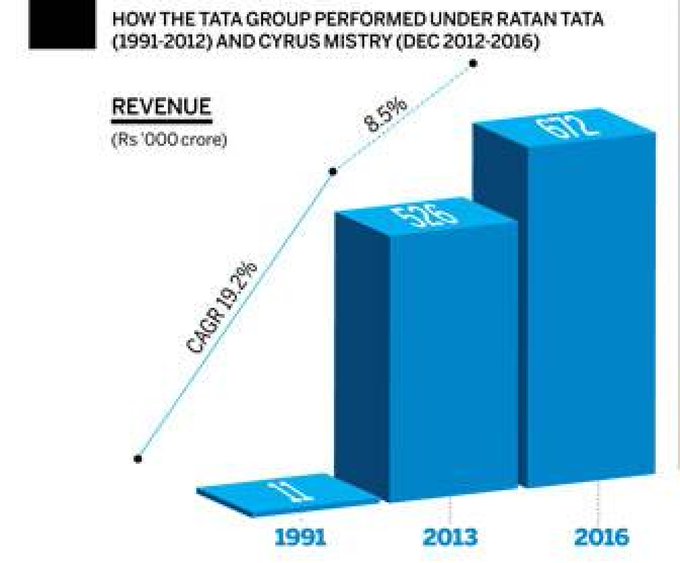
The experience of defeating Rusy Mody and Kerkars came in handy in his later year duel with Cyrus Mistry and subsequent win.
Truly a visionary who taught Indian industrialists the art of acquiring foreign jewels, leverage them for own development and make them Indian. He was sort of a nationalist businessman in the mould of JRD- although a bigger control freak.
What I loved about Ratan Tata the most is that he began when India had pledged its Gold with its own colonizers of centuries (Bank of England), and ended by acquiring top British Jewels (Tetley, Corus, Jaguar) and made them Indian brands. A true nationalist, Ratan was the man who dared to dream and achieved them all.
The remarkable story of a Tata family member, is not about how he defeated all the much powerful group satraps, but how he gave Tata group its current identity while continuing to maintain the ethos, character, and vlues of TATAs.
My Hero! Our Hero!!
Travel well, Sir!
 shwetank's-pad
Leave a comment